 English
 Deutsch
 español
 français
 العربية


Air preparation units are not "one-size-fits-all." Selecting the correct type and configuration is critical for system efficiency and cost-effectiveness.
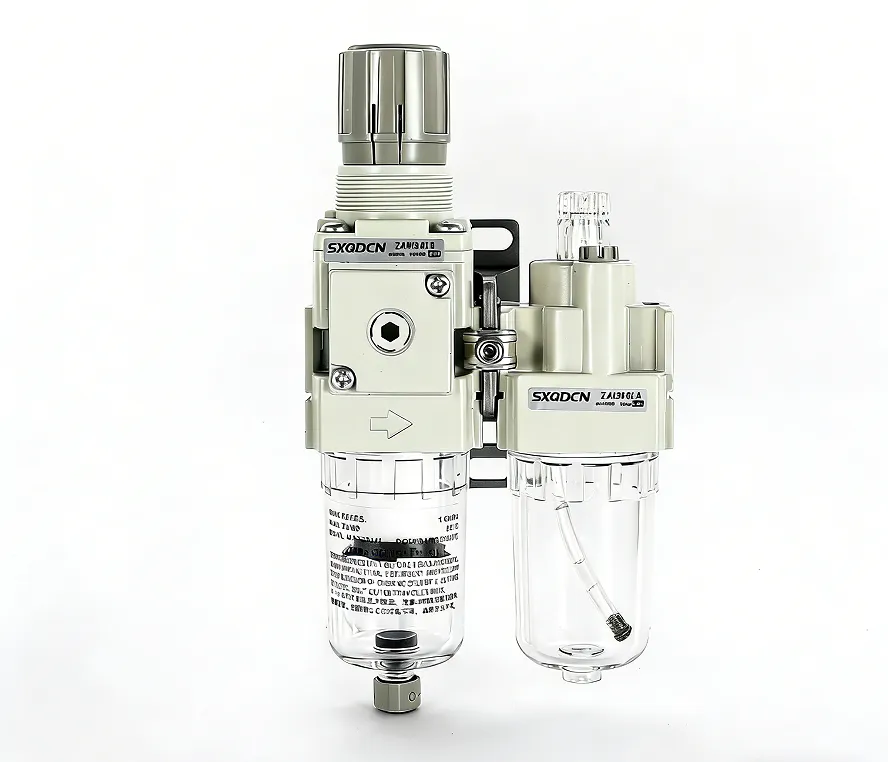
Classification by Configuration & Application:
|
Configuration |
Components |
Typical Applications |
Key Selection Notes |
|
Full FRL Unit |
Filter Regulator Lubricator |
General factory automation, machine tools, pneumatic motors. |
Default choice for most standard machinery using lubricated air components. |
|
FR Unit (Two-Stage) |
Filter Regulator |
Clean/oil-free applications, air logic controls, packaging, medical devices. |
Used with oil-free cylinders and valves. Often employs finer filters. |
|
Filter Only |
Filter (often high-efficiency) |
Downstream of dryers, before sensitive instruments (e.g., sensors, cameras). |
Pure protection. Pressure is managed elsewhere in the system. |
|
Modular Units |
Independent F, R, L blocks |
Customizable large systems, central distribution with branch-specific needs. |
Offers flexibility in sizing and maintenance. Connected via modular brackets. |
|
Miniature/Integrated Units |
Compact F, R, (L) combined |
Small machinery, robotics, confined spaces, single valve/actuator control. |
Saves space. Flow capacity is generally lower. |
Classification by Filter Type & Performance:
General Purpose Filters (5-40 micron): For bulk liquid and particle removal. Standard for inlet protection.
Coalescing Filters (0.01-1 micron): Remove oil vapor and ultrafine aerosols. Essential for instrument air and critical applications.
Adsorbent Filters (Activated Carbon): Remove oil vapor and odors. Final stage for truly oil-free air.
Selection Criteria Checklist:
Flow Requirement (Cv/Kv): Must meet maximum air consumption of downstream devices.
Port Size (NPT, BSPP, etc.): Must match piping. Do not use port size alone to judge flow capacity.
Filtration Level: Match filter fineness to the most sensitive downstream component.
Pressure Range: Regulator must accommodate both supply pressure and required output pressure.
Environment: Consider bowl guards (safety), materials (for corrosion resistance), and auto-drains (for efficiency).